REVIEW · VENICE
Lido Bike Tour: With a Local on the Island of Cinema
Book on Viator →Operated by deTourist Venice Valerio Coppo · Bookable on Viator
Cycle Venice’s quieter film side.
This Lido Bike Tour with local guide Valerio Coppo is a smart way to see the island’s big sights without fighting Venice traffic. I especially like the shortcut feel: you get a guided loop that hits film-festival connections, historic hotels, and local neighborhoods in one half-day. You also get a mix I really value—cinema-era landmarks plus beach-and-nature riding—so Lido feels like its own world, not just a day-trip stop.
One thing to plan for: some paths can be rough and there may be sandy stretches. If you’re choosing a bike, I’d seriously consider wider tires options rather than assuming every surface will be smooth.
In This Review
- Key things that make this Lido bike tour worth your time
- Why Lido is a great bike day (and not just a detour)
- Starting at Santa Maria Elisabetta: your bike choices and comfort
- Jewish cemetery calm and the Sposalizio del Mare ritual at San Nicolo
- The Faro di San Nicolò and the coastline view that ties it together
- Film-festival connections at Grand Hotel des Bains and the Palazzo del Cinema area
- Murazzi seawall riding: a breakwater you can feel in your route
- Alberoni dunes and the feeling of space on Lido
- Malamocco canals: where you trade hotel views for fisherman lanes
- Poveglia and Lazzaretto Vecchio: lagoon-side views with heavy themes
- San Lazzaro degli Armeni and Ausonia Hungaria: faith and restored luxury facades
- Price and value: what you pay for, what you don’t
- How to choose your bike setup for this specific route
- Who this Lido tour fits best
- Should you book it?
- FAQ
- What is the tour duration?
- Where do you meet for the tour?
- How do the bike rentals work?
- What bike options are available and how much are they?
- Is the tour offered in English?
- Is the tour suitable for people with only moderate fitness?
- How many people are on the tour?
- Are the stops included ticketed attractions?
- What should I consider for the route surfaces?
- What happens if the weather is bad?
Key things that make this Lido bike tour worth your time
- Valerio Coppo’s pace stays workable for different fitness levels, which matters on an island loop with canals, piers, and beaches.
- Film-festival links without the crowds: you ride past places connected to Venice’s big annual cinema event.
- Nature routes that avoid busy roads, including forest and protected areas.
- Lagoon islands that change the mood: quarantine and hospital history show up fast once you’re on the lagoon side.
- Beach time that isn’t staged: Murazzi and Alberoni bring real coastline energy.
- Smart bike options (including e-bikes and fat tires) so you can match the ride to your comfort.
Why Lido is a great bike day (and not just a detour)
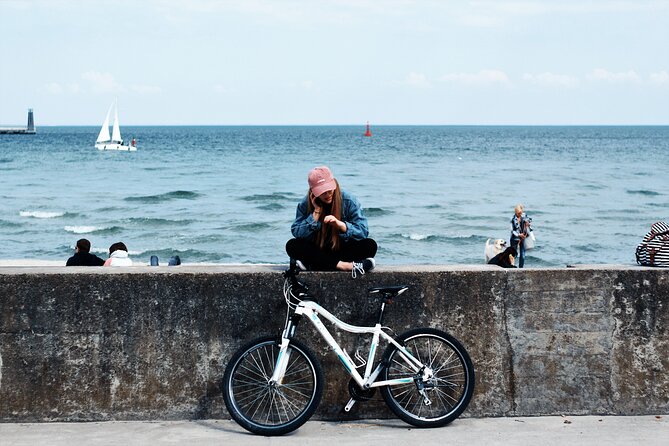
Lido di Venezia sits at Venice’s doorstep, but it doesn’t feel like Venice-on-foot. It’s long, varied, and made for motion—especially by bicycle. You get the sense of a real island rhythm: seaside air, quiet lanes, and water views that keep changing as you move.
The value of a guided loop is that you’re not guessing your route. With a local on board, you get shortcuts to the parts people come for—like film-festival-adjacent locations—while still wandering through calmer corners that feel more like locals’ Venice than postcard Venice.
Also, group size is capped at 10 travelers, which helps. Smaller groups tend to stay flexible when the ride gets bumpy or when someone needs a slower pace.
You can also read our reviews of more cycling tours in Venice

Starting at Santa Maria Elisabetta: your bike choices and comfort
You meet at Santa Maria Elisabetta on Lido Island (30126 Venice). Bikes are rented and organized for you, and you pick the style you want. The bike options and daily rental prices listed are:
- City bike: 10 €
- Tandem: 20 €
- E-bike: 20 €
- Fat bike: 18 €
- E-fat bike: 30 €
If you’re not sure what to choose, I’d base it on two things: surfaces and confidence. One review tip that’s worth taking seriously is that some routes include sandy or rough patches. Wider tires can help with comfort and reduce the number of times you might end up walking the bike for short stretches.
This ride is also described as requiring moderate physical fitness. That usually means steady effort rather than hardcore climbing, but you should still be ready for an active 4.5-hour outing.
Finally, plan on this being a 4 hours 30 minutes experience on the island, ending back at the meeting point.
Jewish cemetery calm and the Sposalizio del Mare ritual at San Nicolo
The tour starts on Lido with Lido di Venezia as your base—then it moves quickly into history that feels surprisingly quiet once you’re off the main tourist lanes.
Stop: Cimitero Ebraico
This cemetery is now a peaceful garden, but it served as Venice’s main Jewish cemetery from 1386 until the 18th century. From the gate, you can see tombs with designs ranging from Venetian Gothic to distinctly Ottoman styles. The contrast is striking: elaborate art details, but the setting is still and garden-like. Because this stop is brief and free, it works well even if you’re not a “cemetery person.”
Stop: Chiesa di San Nicolo al Lido
Here you connect to the old tradition of the Sposalizio del Mare (Marriage of the Sea). This thanksgiving mass used to symbolize Venice’s maritime dominion. Even if you don’t catch a ceremony moment, the context gives you a new lens for the island: Lido isn’t just beaches and hotels—it’s tied to how Venice imagined power on the water.
Both of these are listed as free to visit, which is nice when you want spending to go toward the ride and experience instead of tickets.
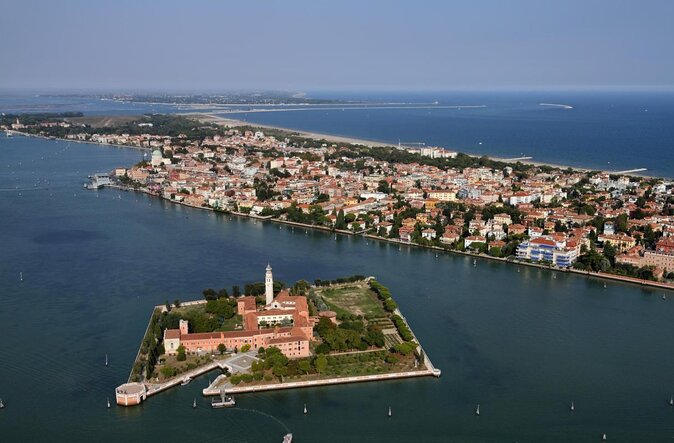
The Faro di San Nicolò and the coastline view that ties it together
Next comes a protected nature stretch, then a move toward the water where you hit the Faro di San Nicolò lighthouse area.
The route described includes an old pier running between the sea and the harbor mouth. That pier-style approach is useful: it places you right where the island’s geography explains itself. From there, you get a real sense of Lido’s coastline, with views toward notable landmark silhouettes like the outlines of the Grand Hotel des Bains and Hotel Excelsior.
This is the kind of stop that makes photos look better than usual—not because you’re chasing a dramatic viewpoint, but because the bike brings you there from multiple angles.
Film-festival connections at Grand Hotel des Bains and the Palazzo del Cinema area
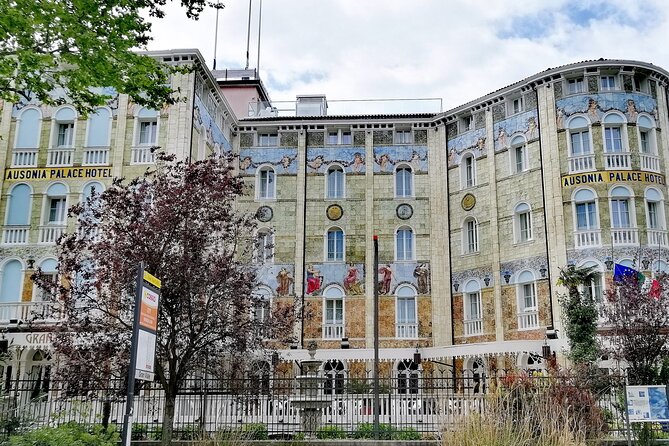
Venice’s film festival is associated with iconic modern glamour, but it also has its older roots—and Lido is part of that story.
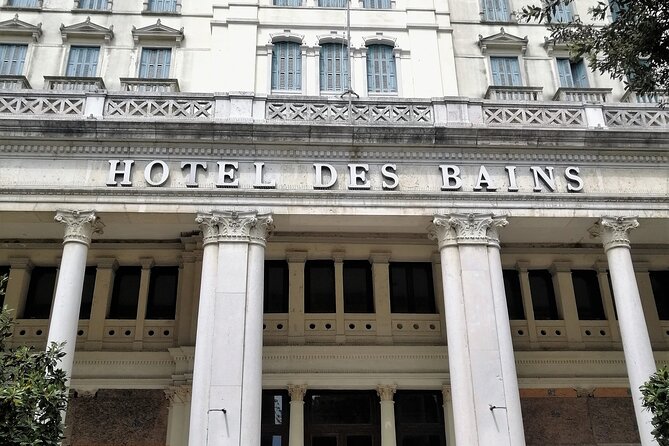
Stop: Grand Hotel des Bains
This former luxury hotel was built in 1900, aimed at wealthy tourists. It’s remembered for literary and film history connections, including Thomas Mann’s stay in 1911. It’s also tied to movie shooting locations connected to films such as Death in Venice (by Visconti, 1971) and The English Patient (1996).
Even when you only see the hotel from the outside, the context you’re given matters. Without a guide, it’s easy to treat it like any other grand façade. With the story attached, you start noticing details like the style language of early 1900s luxury tourism.
Stop: Ristorante Mostra del Cinema
This is linked to the late-August or early-September timing of Venice’s cinema festival, with screenings taking place at the historic Palazzo del Cinema. The Hotel Excelsior (1908) is still in operation, and it’s commonly tied to the festival world—producers and actors often stay there.
These stops are brief, but they create an arc: you go from cemetery quiet and sea-ritual meaning into pure cinema-adjacent atmosphere. It makes the island feel like a stage that runs both in real life and on film.
Murazzi seawall riding: a breakwater you can feel in your route
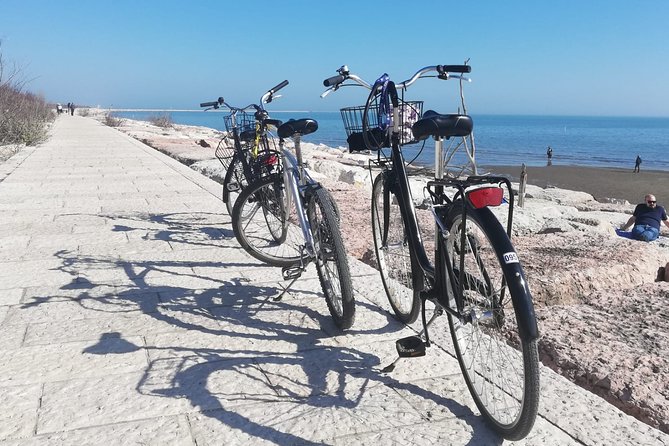
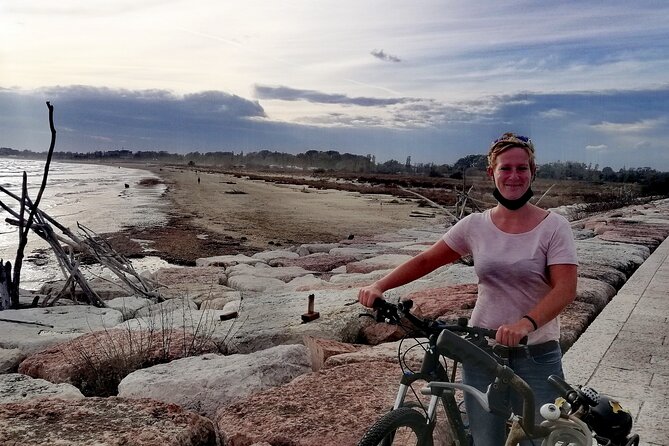
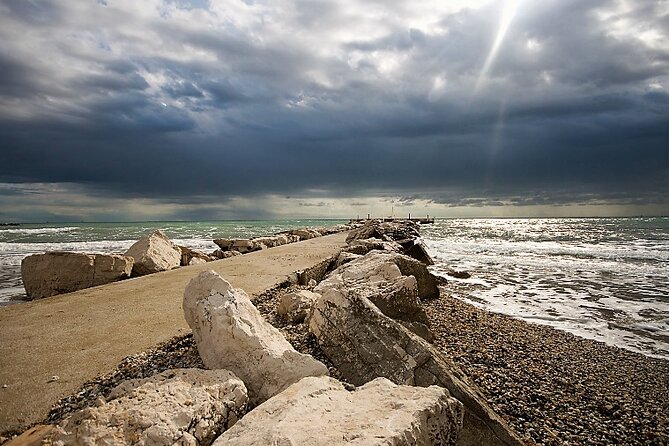
Now the ride gets wilder in a good way. The Murazzi stretch is a scenic route following the Adriatic sea.
Stop: Murazzi free beach
Murazzi is described as an 18th-century engineering work: a designed breakwater that keeps high seas from crashing into the lagoon. Even today, it’s doing its job. Riding alongside that structure makes you understand the island’s survival logic. Venice lives because of engineered water control, and Murazzi is one visible piece of that.
Practically, this section is also a mood switch. Instead of grand hotels and inland lanes, you’re dealing with open air, longer sight lines, and the sense that the sea is always nearby—even when you can’t see everything.
If you like cycling stretches where the scenery does most of the talking, this is a strong segment.
Alberoni dunes and the feeling of space on Lido
After Murazzi, the tour moves into a very different coastal environment.
Stop: L’Oasi delle Dune Alberoni
This is the natural beach area of Alberoni, with a maritime pine forest sloping down toward Lido’s wildest, most scenic beach. The dune fields are referenced as poetic territory, and the description includes the reality that the beach can be nearly deserted.
In practical terms, that means you might get that rare combo on Venice-adjacent days: open space and bird life rather than constant crowds. On windy days you might see kite surfers or windsurfers.
This is also one of the spots where bike choice matters most. If your ride includes sandy bits (and at least part of the route sounds like it does), wider tires or an e-bike can keep things enjoyable rather than annoying.
Malamocco canals: where you trade hotel views for fisherman lanes
At some point, it’s smart to see the island like locals do. That’s where Malamocco enters.
Stop: Malamocco
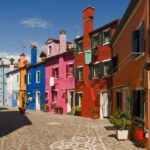
From the beach, you enter a small fisherman village. The route includes crossing Ponte di Borgo and then exploring canals and calli (small lanes), in a less overwhelming lagoon-town vibe than central Venice. You’re also guided toward a handful of churches and a Gothic palazzo, described like a smaller-scale Venice.
The key benefit here is balance. After film-festival glamour and beach scenery, Malamocco gives you “human-scale” Venice energy—quiet streets, water-adjacent living, and architecture that feels daily, not curated.
If you want the tour to feel more like a local bicycle stroll and less like a sightseeing checklist, this is one of the stops that delivers.
Poveglia and Lazzaretto Vecchio: lagoon-side views with heavy themes
Then you shift back to the lagoon side, where the tone changes fast.
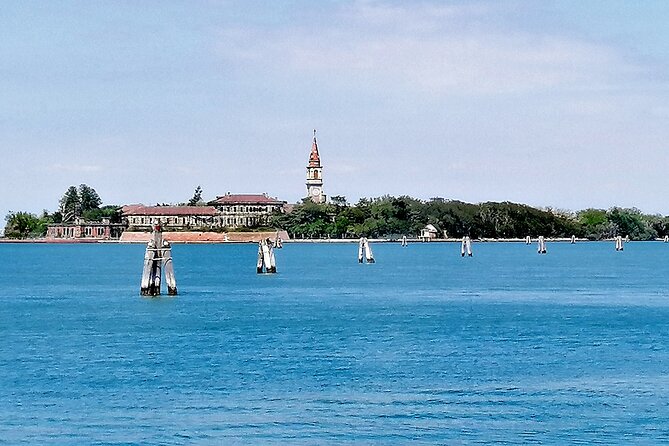
Stop: Poveglia
The route brings views toward Lazzaretto Vecchio. Poveglia’s role is described clearly: from 1776 it was used as a quarantine station for people with plague and other diseases, later becoming a mental hospital, closed in 1968. Because of that past, the island gets attention in paranormal-themed media.
You don’t need to be into that genre to appreciate what you’re seeing. It’s a reminder that Venice’s lagoon wasn’t only about romance and entertainment. It was also a medical and containment landscape.
Stop: Lazzaretto Vecchio
This island is presented as housing, between 1403 and 1630, hospital care during plague epidemics and later a leprosarium. It was later used as a military post too.
Two short stops can’t make you understand centuries of suffering, but a guided approach can help you connect the visible elements to what the island’s purpose was. It also makes the subsequent monastery island feel different: less fear, more devotion.
San Lazzaro degli Armeni and Ausonia Hungaria: faith and restored luxury facades
The tour keeps moving along lagoon views and ends with notable architecture cues.
Stop: San Lazzaro degli Armeni
This small Venetian Lagoon island is home to the monastery of the Mekhitarists, an Armenian Catholic congregation, since 1717. It’s a calm contrast after the quarantine/hospital theme. Even without a long visit, the context helps you read the island as a living religious presence.
Stop: Grande Albergo Ausonia Hungaria
This is Hotel Ausonia & Hungaria, built in 1913, and described as a luxury tourism example from a century ago. One practical detail you’ll likely notice is the ceramic tile work on the main façade, recently renovated.
This stop ties the day together nicely. You’ve seen both extremes: cemetery silence, sea ritual, cinema-world settings, and lagoon islands tied to public health. Finishing with a luxury façade gives you a final reminder that Lido has always been a meeting point between people and eras.
Price and value: what you pay for, what you don’t
The tour price is listed as $203.50 per person, running about 4 hours 30 minutes. That price includes the nature and interpretive guide/tour leader plus the organization and booking of rental bikes if needed.
The bike itself is not included. You pay separately depending on which type you choose (city bike, tandem, e-bike, fat bike, or e-fat bike).
So is it worth it? For me, it’s about three things you can’t easily replicate solo:
- a guided route that avoids busy roads and uses the island’s natural connections,
- interpretive context at each stop (cemetery, sea ritual, lighthouse area, festival-linked hotel world, quarantine islands),
- and the bike setup so you’re not trying to coordinate rentals, directions, and timing on the fly.
Also, the tour is offered in English and is limited to 10 people, which often helps you actually ask questions and keep a smooth pace.
How to choose your bike setup for this specific route
Because parts of the route can be rough and there may be sandy stretches, bike comfort isn’t a side issue here.
If you want the easiest experience:
- choose an e-bike if you’re less confident with sustained riding,
- or choose a fat bike if you expect uneven or sandy ground and want more stability.
If you’re comfortable on regular roads and paths:
- a city bike can work, but it’s smarter to be realistic about the surface conditions you might encounter.
If you’re a group:
- tandems can be fun, but only if everyone agrees on comfort and coordination. Otherwise, splitting into different bike styles is often better.
Who this Lido tour fits best
This experience is a good match if you:
- want Venice scenery with less crowd pressure,
- like mixing beach time with meaningful stops,
- enjoy cycling but don’t want it to feel like punishment,
- and want a guide who can tailor the pace.
It’s also appealing if you’re a film fan who wants the film festival connection without waiting around for the loudest festival zones. You’ll see the architecture cues and locations tied to cinema culture in a way that feels more lived-in than staged.
Should you book it?
I’d book this Lido bike tour if your ideal Venice day includes movement, water views, and short stops with real context—especially if you’re curious about Lido beyond hotels and ferry crossings.
Skip it only if:
- you know you won’t enjoy riding on uneven or sandy surfaces,
- you’re not up for about 4.5 hours of active sightseeing,
- or you want long indoor museum time. This is an outdoor-and-in-between kind of day.
If the weather looks good, this is one of the more practical ways to see Lido’s many faces without turning it into a stressful route-planning project.
FAQ
What is the tour duration?
It runs for about 4 hours 30 minutes.
Where do you meet for the tour?
The meeting point is Santa Maria Elisabetta on Lido Island (30126 Venice).
How do the bike rentals work?
You choose your bike style (city bike, tandem, e-bike, fat bike, or e-fat bike). The bike itself is priced separately, and the tour includes organizing the rental if needed.
What bike options are available and how much are they?
The listed options are: city bike (10 €), tandem (20 €), e-bike (20 €), fat bike (18 €), and e-fat bike (30 €).
Is the tour offered in English?
Yes, the tour is offered in English.
Is the tour suitable for people with only moderate fitness?
The activity is described as suitable for travelers with moderate physical fitness.
How many people are on the tour?
It has a maximum group size of 10 travelers.
Are the stops included ticketed attractions?
Each listed stop is shown as Admission Ticket Free.
What should I consider for the route surfaces?
The route includes some areas that can be rough and may involve sandy paths, so having a bike that feels stable to you matters.
What happens if the weather is bad?
The tour requires good weather. If it’s canceled due to poor weather, you’ll be offered a different date or a full refund.